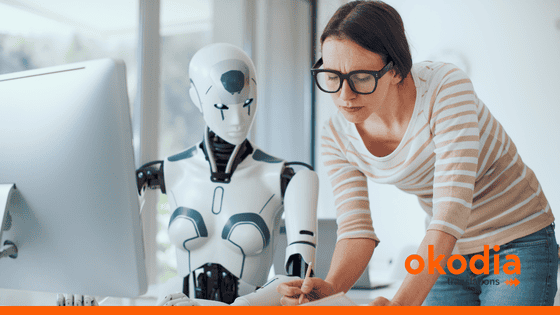
Artificial intelligence is the talk of the town. It’s used for everything, even translation, but this poses an invisible danger to those who aren’t familiar with our industry. Like all tools, it can be very useful, but also very risky if you don’t know how to use it properly. If you wouldn’t trust a plane controlled by a machine without human supervision, why would you entrust a text to a machine without supervision?
That’s why we at Okodia are introducing a new service called Human-in-the-Loop (HITL). So, we’re riding the wave—but we’re doing it the smart way. With Human-in-the-Loop, we make the best possible use of artificial intelligence, but always in collaboration with expert humans who know how to guide it and review the text to minimize risks as much as possible. In addition, we guarantee the confidentiality of the document, unlike other online translation engines.
What is Human-in-the-Loop?
Many companies are already using AI to translate their content. There’s no denying that it’s easy to use, reduces costs, and helps manage volumes that were previously difficult to handle. Human-in-the-Loop offers all of that as well, but with an added benefit: the AI is supported by a human who makes the decisions, so that the AI doesn’t make them without taking into account factors such as cultural context, brand tone, or specific glossaries.
What are the phases of a typical translation project using HITL?
Phase 1: Receipt and Analysis of the Assignment
When we receive an order, our team reviews the document to ensure that it’s suitable for translation using artificial intelligence, since not all texts can be translated with AI. If your text falls under this category, we’ll offer you the most convenient option.
Neither can the document be processed any which way. You can’t always copy text from a PDF and paste it as-is into the AI tool. Our project managers are responsible for identifying each client’s translation needs, assessing the quality of the layout, and identifying potential risks and technical requirements to prevent any problems going forward.
The project managers also check what needs to be translated and what doesn’t (in case some graphics are left untranslated because they aren’t in an editable format and the AI doesn’t detect them) and whether that translation will meet the requirements of the agency requesting it, if any. In other words: our team conducts a preliminary analysis to minimize risks. Indeed, we use AI, but we lay the groundwork for it and guide it to produce the best possible translation.
Phase 2: Preparing the Environment
Once the quote has been approved, we at Okodia select the machine translation engine that best suits the text’s needs. All things considered, Ryanair might be fine for a short flight, but no one would want to spend 14 hours crammed into one of its planes. The same is true of machine translation engines as each one works differently and, therefore, some perform better with certain types of text than others.
In addition, we provide the AI with the prompts best suited for each client and document. This is how we check whether the translated text is more formal, less formal, and whether it uses more or less specific vocabulary. We can also add a glossary to ensure that those specific terms are used and not others. In other words, we provide the AI with a clearly marked path so it can get to where it needs to go.
Phase 3: Production
The machine translation engine provides a translation in accordance with the guidelines set by the project managers. This text is reviewed by a professional translator to ensure that the vocabulary is appropriate, the tone is suitable for the text, and consistency and style are maintained throughout the document. In addition, the translator detects potential cultural errors and determines which term is the most accurate one for the specific text. It also ensures that the text complies with the guidelines the client provided at the start of the project.
Phase 4: Quality Control
After a professional translator has reviewed the translation, the project managers get back to work to perform final checks: they make sure there are no terminology errors, double spaces, inconsistencies, or agreement issues. Once this more formal quality control process is complete, a general review is conducted to ensure that each client’s specific requirements have been met. Finally, the document’s format is checked to ensure that the layout is flawless and that the client receives a file that is ready to use or publish.
Confidentiality: The Ultimate Major Advantage
In addition to guiding AI and reducing risks, Human-in-the-Loop has another major advantage: data confidentiality. The document is used solely to provide the translation and, when working with our translation engines, is neither stored nor used for training the translation engine itself. Therefore, neither the information, nor the translation, nor the original text is being sent.
FAQs
What’s the difference between the “human-in-the-loop” approach and relying solely on AI?
As the name suggests, in a “human-in-the-loop” system, humans are responsible for guiding the AI and verifying its translation. Furthermore, when it comes to Okodia’s services, confidentiality is guaranteed. However, artificial intelligence only translates the text; it doesn’t verify anything or add any additional steps to the process.
Is the confidentiality of the files protected?
The document is used solely to provide the translation. It’s not stored in any way, so you can rest assured that confidentiality is guaranteed.