
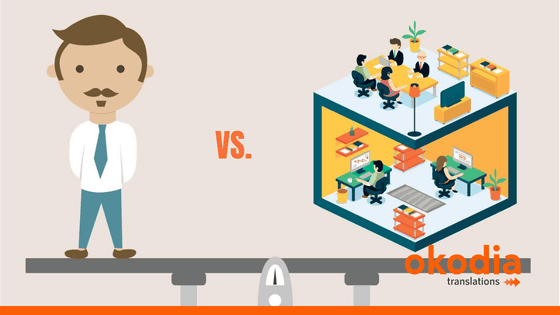
If you need to translate a document, website or any other type of content, you may be wondering about the differences between a translation agency vs freelance translator. Choosing between a translation agency vs freelance translator depends on the type of project, the languages involved and your specific requirements.
A freelance translator can be an excellent choice for individual assignments, while a translation company offers additional advantages when managing more complex projects, multiple languages and structured quality assurance processes.
Below, we compare the main differences to help you decide which option is right for you.
Translation Agency vs Freelance Translator: Key Differences
| Translation Agency | Freelance Translator |
|---|---|
| Manages multilingual projects | Usually works with one or a few language pairs |
| Extensive network of specialist translators | Expertise limited to individual areas of specialisation |
| Greater capacity for urgent projects | Availability depends on current workload |
| Certified processes and quality assurance | Revision usually carried out by the translator alone |
| Dedicated project management | Direct communication with the translator |
More Languages and Greater Specialisation
One of the biggest advantages of working with a translation agency is the ability to manage multilingual projects through a single point of contact. If you need your content translated into English, French, Italian and Portuguese, you won’t have to find a different translator for each language or coordinate multiple delivery schedules yourself.
Translation companies also have access to a much wider range of languages, including less common ones such as Tamil, Mongolian or Afrikaans. Finding an experienced freelance translator for these languages can often be much more challenging.
Another advantage is access to a large network of specialist linguists. This enables each project to be assigned to the translator with the most relevant expertise, whether in medical, legal, technical, pharmaceutical, financial or marketing translation.
Better Equipped to Handle Complex and Urgent Projects
Freelance translators manage every aspect of their work themselves, so their availability depends entirely on their existing workload.
A translation agency, on the other hand, has a team of professionals capable of handling larger projects, coordinating multiple languages simultaneously and responding more effectively to urgent requests. If unexpected circumstances arise, work can often be reassigned to another specialist translator, helping to minimise delays.
This level of organisation is particularly valuable for businesses that regularly translate documentation or manage international projects.
Certified Processes and Quality Assurance
Another important difference lies in the internal processes.
Many professional translation agencies hold internationally recognised certifications such as ISO 17100, ISO 9001 and ISO 18587. (At Okodia, we are certified to all three standards.) These certifications demonstrate compliance with strict requirements relating to project management, translator selection and translation revision.
Maintaining these certifications requires agencies to follow clearly defined procedures and successfully complete regular external audits. In return, they can provide translation certificates confirming that the work has been completed in accordance with the relevant ISO standard.
In addition, many agencies apply an extra layer of quality assurance before delivery. Beyond the translator’s own revision, a final review checks terminology, formatting and compliance with the client’s instructions. This additional quality control helps reduce errors and provides extra reassurance, particularly for specialist translation projects.
Which Option Should You Choose?
There is no single answer. Both a translation company and a freelance translator can deliver excellent results when they have the right experience for your type of content.
If you only need a one-off translation into a single language, a freelance translator may be the right solution. However, if your project involves multiple languages, specialist subject matter, tight deadlines or comprehensive project management, a translation agency will often provide greater coordination, flexibility and quality assurance throughout the process.
Ultimately, the most important factor is choosing a provider with proven expertise in your industry and the ability to meet your specific requirements.
Frequently Asked Questions
What is the difference between a translation agency and a freelance translator?
The main difference is the way the work is organised. A freelance translator manages every stage of the project personally, while a translation agency coordinates teams of specialist translators and applies additional project management and quality assurance processes.
Which option offers better translation quality?
Translation quality depends primarily on the expertise and experience of the professional carrying out the work. Both a translation agency and a freelance translator can deliver excellent results when they have the appropriate knowledge of the subject matter.
When should I hire a translation agency?
A translation agency is often the best choice if you need translations into multiple languages, have high-volume projects, work to tight deadlines or require certified processes that provide additional quality assurance.