Halloween is one of the main themes in American films. So much so that it might seem as though this festival originated in the United States, but its history goes back much further. Samhain, also known as Samaín in Galicia, is an ancient festival with Celtic roots that marked the end of the harvest season.
Although Samhain is particularly associated with Ireland and Scotland, traditions linked to this time of year can also be found in other regions with a Celtic cultural heritage, including Galicia. But what’s the connection between Samhain and Halloween? And which Galician traditions are associated with this celebration?
The Celts and the seasons
The main Celtic festivals were linked to agricultural and livestock cycles. Traditionally, the year was divided into two main parts: the dark half and the light half. The dark half of the year began with Samhain, while the light half began with Beltaine.
The four major festivals were:
- Imbolc, which marked the beginning of spring and was associated with fertility and the start of the animals’ birthing season.
- Beltaine, which marked the beginning of summer and the time when the flocks were taken up to the higher pastures.
- Lughnasa, celebrated in August and associated with the start of the harvest season.
- Samhain, which marked the end of the harvest and the beginning of winter, when the flocks were driven down to their winter pastures.
Samhain was therefore not solely associated with the dead and the supernatural world, but also with the change of season and the agricultural and livestock cycles.
Samhain rituals
Samhain also had a significant supernatural dimension. According to the traditions associated with this festival, during the celebrations, the boundary between the world of the living and that of the dead would blur, allowing the spirits of the dead to return to the world of the living.
It was considered important to welcome them properly and offer them food and drink, as it was believed that they could protect the family and the livestock during the winter.
This connection with the dead and the supernatural world is one of the reasons why Samhain is regarded as one of the main cultural precursors to Halloween, although the modern celebration also incorporates other traditions.
Costumes, offerings and ‘trick-or-treating’
Some traditions associated with Samhain included wearing costumes and going from house to house to ask for food or offerings. The costumes might have included animal skins and other items designed to give the wearer a supernatural appearance.
These traditions bear similarities to modern-day trick-or-treating, although it cannot be said that this modern tradition stems directly from any single Samhain custom.
Samhain in Galicia
Galicia has numerous folk traditions relating to the dead, bonfires and the supernatural. In recent decades, there has also been a cultural revival of Samhain, with celebrations and activities taking place in several towns across Galicia.
Among the elements associated with these celebrations are bonfires, games and hollowed-out vegetables lit with candles.
This contemporary celebration should not necessarily be seen as an exact reproduction of the ancient Celtic festival, but rather as a revival and reinterpretation of various elements of Galician tradition and popular culture.
The Santa Compaña
One of the best-known legends in Galicia is the Santa Compaña, which tells of a night-time procession of souls or the dead.
According to different versions of the legend, a living person carried a cross and led a procession of hooded souls who moved forward in silence, carrying candles. Coming across it was considered a bad omen.
The tradition is also found in different forms in other parts of the northwest of the Iberian Peninsula, particularly in Astoria.
Turnips, pumpkins and Halloween
To decorate their homes, some European traditions involved using turnips and other vegetables that had been hollowed out and lit with candles. These elements were linked to varied beliefs about the dead and the supernatural world.
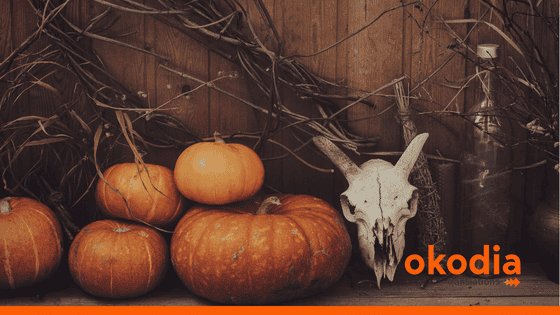
When these traditions reached the United States, turnips were largely replaced by pumpkins, which were more plentiful and easier to hollow out. This is how the famous jack-o’-lanterns – one of the most recognisable symbols of Halloween – became popular.
The Celtic Halloween
Galicia is not the only region with traditions linked to the supernatural at this time of year.
In other areas with Celtic and Gaelic cultures, such as Ireland, Scotland and Wales, we find similar rituals and traditions, albeit with their own distinctive features.
In Wales, for example, there’s the tradition of the Mira Clwyd, which entails an individual carrying a horse’s skull and covered with a sheet, which would go from house to house to collect offerings.
Although these traditions are not identical, they share certain elements with modern Halloween celebrations: costumes, supernatural beings, going from house to house, offerings and a symbolic connection with the dead.
Samhain: the precursor to Halloween
So, does Halloween have its origins in Samhain?
The answer isn’t quite that simple. Samhain is one of the main cultural origins of Halloween, but the modern celebration is the result of the evolution and blending of different traditions.
Samhain brought with it elements associated with the end of the harvest, the change of season and the world of the dead and spirits. Other traditions were subsequently incorporated, including those relating to All Saints’ Day and All Souls’ Day.
In fact, Halloween comes from the English term ‘All Hallows’ Eve’, which means ‘the eve of All Saints’ Day’.
This is why, although we now mainly associate Halloween with the United States, its history has much older European roots and links traditions from different cultures, including those of Galicia.
And now that we know a bit more about its history… Happy Samhain and Happy Halloween!
FAQs
What are the origins of Halloween?
The origins of Halloween are complex and it’s actually the result of the evolution of various traditions. Samhain is one of its main cultural influences, although other European celebrations and traditions also played a part.
What is Samhain?
It’s an ancient festival with Celtic origins that marked the end of the harvest season and the beginning of winter. It was also associated with the world of the dead and spirits.
Why do people decorate pumpkins during Halloween?
The tradition is linked to ancient European traditions in which turnips and other vegetables were hollowed out so that candles could be placed inside them. In the United States, pumpkins eventually replaced turnips and became one of the symbols of Halloween.