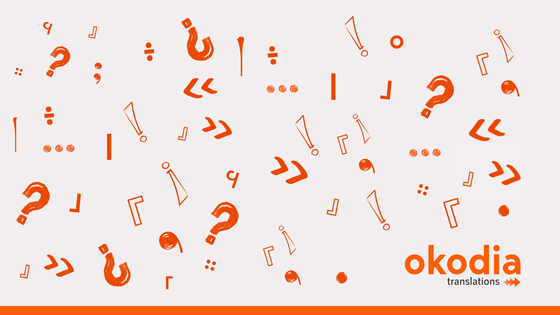
Punctuation marks are written symbols that help structure a text and make it easier to understand. They are used to separate ideas, indicate pauses, mark questions or exclamations, and avoid ambiguity. Although many languages share some punctuation marks, each writing system has its own rules and even some unique symbols of its own.
In this article, we look at some of the world’s most unusual punctuation marks and how they vary between languages.
Punctuation marks
Like alphabets, punctuation marks can also vary between languages. For example, although Spanish and English both use the Latin alphabet, Spanish is one of the few languages that has opening marks for exclamations and questions (¿?, ¡!).
But what about other languages? Do languages such as Japanese or Russian use the same punctuation marks as languages that use the Latin alphabet?
The full stop in Japanese and Chinese
In some East Asian writing systems, punctuation marks differ from those we use in English. For example, Chinese and Japanese use this rounder-looking full stop to mark the end of a sentence. It looks like this:
我很好。
However, although many Asian languages use it, not all of them do. For example, Korean and Vietnamese use the same punctuation marks we are used to. In fact, Vietnamese is one of the few languages in the region written in the Latin alphabet, because Jesuit missionaries adapted the Latin alphabet to transcribe the sounds of the language and make it easier to learn.
The enumeration comma 、
As with the full stop 。, languages associated with scripts influenced by Chinese share another distinctive punctuation mark: the enumeration comma (、). As its name suggests, it is used either to list items or to separate elements within a list.
Quotation marks 「 」 and 『 』
These writing systems also use distinctive quotation marks to indicate quotations or highlight titles. However, they are not widely used in simplified Chinese, although they do appear in Korean, especially in academic publications.
彼は「こんにちは」と言った。
나는 『어린 왕자』를 읽었다.
In addition, angular quotation marks 《》 are used in China. In fact, the use of quotation marks varies quite considerably even between languages that share the Latin alphabet. For example, in English we usually use double quotation marks (“…”), in Spanish angular quotation marks («…») are more common, and in German low-high quotation marks („…“) are used.
Inverted punctuation
Punctuation marks in Arabic are particularly striking because this writing system is read from right to left, which changes the orientation of some symbols. You could say they are the same as the punctuation marks we are used to, but facing the opposite way. These punctuation marks are also used in Central Asian languages such as Persian, Urdu, Sorani Kurdish and Pashto.
Question mark: كيف حالك؟
Comma: امروز هوا خوب است، اما کمی گرم است.
Semicolon: اجتهد في دراسته؛ فنجح في الامتحان.
The danda: an Indian punctuation mark
Many Indian writing systems, such as traditional Hindi and Sanskrit, use this sign (। ), called a danda, to mark the end of a sentence.
यह एक पुस्तक है।
It is probably one of the oldest punctuation marks still in use today. In Sanskrit, danda means stick or staff. There is also a double danda, which indicates a stronger division, such as the end of a stanza or chapter.
Tibetan uses a sign very similar to the danda, the shad (།), to mark the end of a textual unit.
Punctuation marks that do not mean what they seem to mean
If you read the following on a sign, would you imagine it was a question?
Τι κάνεις;
It turns out that in Greek, the semicolon is used to ask a question and, when Greek writers want to achieve the same effect that we create with a semicolon, they use a raised dot (·). By contrast, Tibetan uses this raised dot, known as a tsheg, to separate syllables.
Punctuation marks in Ge’ez script
One of the most interesting cases is found in the Ethiopian script, also known as the Ge’ez script, which is used for African languages such as Amharic and Tigrinya. It is especially interesting because these marks are not adaptations of European signs, but emerged from medieval African traditions.
| Ethiopian sign | Equivalent | Example |
| ። | full stop | ይህ መጽሐፍ ነው። |
| ፣ | comma | ሰው፣ ፈረስ፣ ውሻ |
| ፤ | semicolon | ዝናብ ይዘንባል፤ መንገዱ ይረጥባል |
| ፥ | colon | ሦስት ነገሮች አሉ፥ ውሃ፣ እሳት፣ አየር |
| ፨ | paragraph separator | ይህ የመጀመሪያው ክፍል ነው። ፨ ይህ ሁለተኛው ክፍል ነው። |
What if punctuation marks were not placed at the end?
Armenian uses a highly original punctuation system, because the marks are not placed at the end of the sentence, but above the relevant final vowel or syllable. This script, developed by the monk Mesrop Mashtots (AD 362–440), does not treat a question or exclamation as affecting an entire sentence, but instead marks the word that carries the interrogative or emotional force, which is what makes it so complicated to use. Some examples are:
Exclamation: Գեղեցի՜կ
Question: Ինչպե՞ս ես
The unusual case of Thai
After all these unfamiliar punctuation marks, Thai deserves a section of its own. For a start, Thai does not use spaces between words, but between larger units, such as phrases or sections of text. It is up to the reader to identify where one word ends and the next begins. And, as if that were not enough, the final full stop is usually omitted.
ฉันชอบกินข้าว: although it may look like a single word, it is a complete sentence meaning “I like eating rice”.
In Thai, many signs are used to indicate omissions. For example, the paiyannoi (ฯ) indicates that a word is an abbreviation, while the mai yamok (ๆ) shows that the previous word should be repeated (เร็วๆ is the same as เร็ว เร็ว).
Conclusion
Punctuation marks are much more than simple written symbols. They reflect the history, culture and evolution of each writing system. Although some languages share similar rules, others use completely different marks or give them different functions. Understanding these differences is essential in translation, localisation and international communication.
Frequently asked questions
Which languages use different punctuation marks?
Many languages use their own punctuation marks or apply different rules. This is the case with Japanese, Chinese, Arabic, Armenian, Greek, Tibetan and languages that use the Ethiopian script, among others.
Do all alphabets use full stops and commas?
No. Although full stops and commas are common in many languages, some writing systems use other equivalent symbols or follow different punctuation rules.
Are punctuation marks common across languages?
Some languages do share punctuation marks, but others have their own marks or their own rules.
Are there any languages that do not use final full stops?
Yes. Thai does not usually use a final full stop, and there are other languages that use the same concept but represent it with a different symbol.