As World Russian Language Day falls on 6 June, we would like to take the opportunity to share some interesting facts about this fascinating language. It is considered one of the most difficult languages in the world and is one of the languages least familiar to Spanish speakers.
The global spread of Russian
According to Ethnologue, Russian is the seventh most spoken language in the world, with around 150 million native speakers and 110 million people who speak it as a second language. It is the official language of 4 countries: Russia, Belarus, Kyrgyzstan and Kazakhstan. It is also the language with the largest number of speakers in Europe.
Russian in international institutions
It is one of the six official languages of the UN, alongside Arabic, Chinese, Spanish, French and English. It is also one of the four official languages of ISO standards in areas such as quality, the environment, energy, food and occupational health and safety, among others.
The alphabet
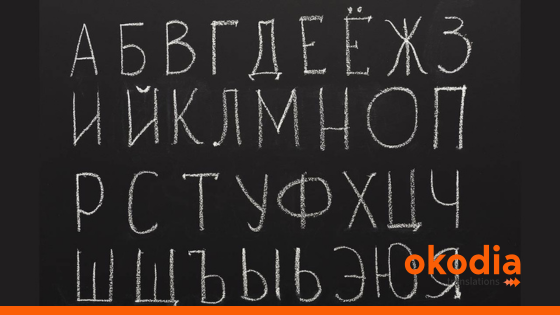
Another interesting fact about Russian? It is written using the Cyrillic alphabet. This alphabet originated in the 9th century within the Slavic Christian world. At the time, the Byzantine Empire wanted to evangelise the Slavic peoples, but to do so it needed to translate religious texts. With this idea in mind, two missionary brothers called Cyril and Methodius developed a writing system known as the Glagolitic alphabet. After the death of the two brothers, their disciples simplified and adapted the system. Despite what many people may believe, the Cyrillic alphabet originated in Bulgaria, not Russia. Initially, the original Cyrillic alphabet had 40 letters, but it was reformed several times, including by Peter the Great in the 18th century and after the Russian Revolution.
Today, the Cyrillic alphabet consists of 33 letters, of which 21 are consonants, 10 are vowels and 2 letters have no sound: the hard sign “ъ” and the soft sign “ь”.
Grammar
One of the greatest difficulties faced by students of Russian is verbal aspect. There are two: perfective and imperfective. The first is used to indicate that an action has been successfully completed, while the second is used for actions that have not had a specific end point or whose completion is uncertain.
Another interesting fact about Russian is that it contains many French words. This is because the tsars admired French culture and art, so they began to copy certain terms, such as tуалет /tualet/ (toilet, from the French toilette) or Бульон /bul’on/ (stock, from the French bouillon).
In addition, the verb “to be” is only used in the past and future, and the verb “to have” is hardly used. That is why you would literally say something like “I translator” and “at me house” to mean “I am a translator” and “I have a house”, respectively.
Like German, Russian does not use articles, but declensions instead. There are 6 in Russian, and the language has three genders: masculine, feminine and neuter. It is important to know the gender of each noun, as this affects the endings of other words due to declensions.
A little vocabulary
The Russian language has more expressions for shades of blue than most other languages. In fact, it divides these shades into light (голубой) and dark (синий). This is especially interesting because some languages use a single word to refer to both green and blue.
Russian surnames vary according to the gender of the person who bears them. In Russia, names are made up of a first name, a surname and a patronymic. This patronymic is formed using the father’s first name and the ending –ovich for boys and -ovna for girls. In other words, if a man has a daughter and a son, the girl’s patronymic will be Kirillovna and the boy’s will be Kirillovich.
Do you know any more interesting facts about Russian that you would like to share with us?
FAQ
Russian is written in the Cyrillic alphabet.
Russian is a language and Cyrillic is an alphabet. However, Russian is not the only language that uses the Cyrillic alphabet. For example, Macedonian is written in Cyrillic, and Serbian can be written in both Cyrillic and Latin script, which is the name of our alphabet.
There are variations. The Moscow variety is considered standard Russian, although there are many dialects, which are in turn divided into three main groups: northern, southern and central dialects.